
 |
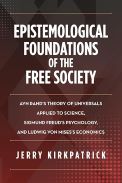
Epistemological Foundations of the Free Society: Ayn Rand's Theory of Universals Applied to Science, Sigmund Freud's Psychology, and Ludwig von Mises's Economics
by Jerry Kirkpatrick
Kirkpatrick Books
Stripping away philosophy and science to their barest essentials, Ayn Rand focused on epistemology and how we organize and group subjects into broader categories to properly define our world. For Rand, this served as a nucleus of ideas that could establish one's capacity to view the world with objectivism in mind and to form concepts that allowed a person to go through life in a man-made society. The author of this book takes these ideas as a bedrock and applies them to the human sciences of psychology and economics, examining seminal thinkers not to exonerate any criticisms or serve as an apologist, but to explain how free societies develop and persist. For the objectivist everyman, this book outlines how we develop and utilize knowledge, and how that very nature determines what can truly offer lasting happiness and room for fulfillment.
One of the dangers of a book like this that the author deftly avoids is that it can rely too much on familiarity with the source materials. Instead, readers can find an outline of how they and others around them already use these concepts daily, and from there frame an examination of widely held beliefs and proven or disproven social concepts. By using Freud and von Mises as onramps, their fields can be addressed without establishing a full theoretical framework or list of suppositions. The discussion and consideration collected here is intellectual and comprehensive, but at the end of the day this is meant to be practical, useful information, and the author is careful not to let it get caught up in theory and the ephemeral. While some familiarity with Rand will give readers a head start, all are able to use this as a primary source to get familiar with her theories and ideas.