
 |
In darkness, one often makes out the shapes of hulking monsters. If we see their outline, then they must be there. The first book in the Holiday Spirit series tips this idea on its head. Rather, it is the darkness that masks a mystery, not a so-called monster. Children in the town of Killington, Vermont, go missing. Unlikely heroes rise up, including Saul Frankenstein, Dr. Ralph Ellison, the werewolf Aoife, and Count Dracula. These "monsters" battle a witch to keep the townsfolk safe, the opposite of what one familiar with their past histories would expect.
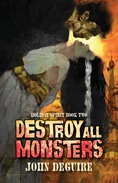
In this second book of the series, the same cast of monster-heroes, along with other familiar characters, arrive on the scene in Paris and London. A thrilling chase by Aoife to rescue her husband, Count Dracula, requires Saul's help in a helicopter above Aoife's motorcycle atop a fast-moving train. After crash-landing in Canada to snippets of French conversation, they wake up in Paris to clipped, calm tones of a therapy session in progress. Weather plays a significant role as this story unfolds, from the rain's wicked twists in London to a snowy landscape where Saul faces up to his thoughts.
One of the marks of good writing is how easy it is to draw positive comparisons. For example, DeGuire can be compared to his fictional character, Saul Frankenstein, who offers support to those on adventures or who find themselves in danger. DeGuire, a retired physician and surgeon, lets a reader don a scientist's mind while encountering a world of monsters, townsfolk, and unexpected love. Similarly, Michael Crichton, also a doctor, attended Harvard Medical School, a perspective that added greatly to his book Jurassic Park. Like the inhabitants of Jurassic Park, larger-than-life monsters tread the streets of real-world locations, such as Paris, London, or Vermont, in DeGuire's sequel. There's even a thrill factor to the sequel's cinematic opening, as awe-inspiring as arriving at Jurassic Park for the first time.
Moreover, DeGuire's love of comic books shines through in this novel. From the very first scenes of a high-speed train, a helicopter, and a werewolf intensely riding a motorcycle, an imagined comic's pages flip by. It's immediately immersive and fast-paced. These moments find fuel in DeGuire's writing environment: a cold winter at his childhood home, silent, snowed in, and laden with memories. It was in these extreme weather conditions that he thought of his family and the magic of holidays. No matter the environment, whether that's Paris or London for the monsters, resilience prevails. Magic isn't snuffed out by a harsh winter or waking up in France instead of Canada. Love pushes through, as it does for these monsters, who do not recoil from challenges but gain strength through them.
Sharing something important about the human or monster spirit also goes back to the making of Louisa May Alcott's Little Women at Orchard House. She would sit down to write in a home bustling with family life and activity, as characters came and went, with bits of news and story like birds dropping off a nest's materials. That hum of a cast of characters, love clicking locks like the famous bridge, is there in DeGuire's sequel, but there's an interesting quality to the chosen narrator—Saul Frankenstein. He's almost like Nick Carraway of F. Scott Fitzgerald's The Great Gatsby. He's unquestionably vital to the story, as is clear as the sequel comes to a close—a steady presence as the book first opens with the helicopter in the sky, a medical professional on standby.
RECOMMENDED by the US Review