
 |
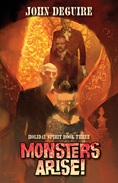
DeGuire's third volume in his Holiday Spirit series opens eerily and mysteriously. A dark rider finds himself in a land of Yetis and woolly mammoths. Count Dracula announces his presence. Only one month before, an explosion had destroyed most of the structures on Dr. Moreau's island. The count had survived an abundance of violence thanks to a few unlikely friends. As the story unfolds, other characters—such as Count Dracula's werewolf contessa wife, Aoife—emerge and reveal their own horrifying stories. Even Dr. Ralph Ellison, the invisible man, has a role in the new life that Dracula and his wife pursue in an unlikely place—America. However, as evil threatens to engulf the globe, the "monsters" realize they must take an unlikely role in protecting the world.
As the monsters' adventures take them across the globe and into unusual places, they teach the book's audience a valuable lesson about unity. Each monster possesses their own aptitudes and gifts. Throughout their rollicking adventures, they also encounter numerous adversaries and conflicts. They must put aside their differences and work together to save not only themselves but also each other and the world.
Part of this book's charm is the subtle humor one finds at the most climactic moments. One of the most memorable examples of this is when Dracula insists that he could not tell the difference between Frankenstein and a robot. When Frankenstein insists that Dracula should have been able to tell the difference, Dracula declares, "I can't bite a robot." This is also a memorable scene because it captures the quiet, intimate camaraderie between the two monsters.
Interestingly, the book also raises discussion points about artificial intelligence. At one point, after encountering a mecha-Frankenstein, the real Frankenstein wonders, "Who knows what level of cognizance the self-learning AI bot had developed? Did it learn to love or hate? Or reason the difference?" This moment in the book is pivotal and highly immediate, as ongoing conversations about the rise of AI and its role in society grow increasingly alarmist. In this, the book's characters challenge the audience to consider who the real monsters are in society. This, too, opens discussions about humankind's selfishness and the manipulation of science. Classically, Dr. Moreau embodies these evil ideals most, especially as he takes robotics and technology to a new, terrifying level.
For fans of classic literature and the monsters that have fueled their imaginations for decades, if not centuries, this book is a wonderful fusion of literature's best monsters and worst villains. It challenges individuals to consider ethical questions in science and reiterates positive ideas about the power of unity in the face of adversity. Throughout the text, readers will find positive mantras that are applicable to and useful in navigating today's socio-political landscape. For instance, the monsters understand that defeating autocracy means "Reuniting togetherness and the camaraderie of man" and that even when evil seems impossible to defeat, there is always "Certainly a time for men and monsters to arise and live again." This is a riveting, wild page-turner that has the potential to introduce a new generation of horror fans to the original monsters the genre owes so much to.