
 |
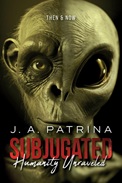
Humans didn't simply show up around 2,200 B.C. and start building civilizations. Some explanations involve cellular mutations. Another explanation is to trace the history of humankind as an alien subspecies. In Patrina's theory, what began as an unnatural origin story morphed into two groups of cross-breeds: Primates/Socialists and Aliens/Libertarians. Fighting against each other and nature itself carries echoes of a past shaped by another species.
The first part, "THEN," of the book examines ancient Hebrew and Eastern texts from 4,000 B.C. to 1,000 B.C. The range is wide, including people groups such as the Sumerians, Greeks, Canaanites, Indians, Chinese, and more. Through the context of aliens, the examination starts with a major piece of evidence, the saga of the Nephilim Giants, and progresses through history. "NOW," the second part, tracks the impact of alien genetics on today's political divides. In this theory, one's genetic tendency is either for Primate, seeking the order and safety of a troop, or Alien, desiring self-determination and taking risks. This longing translates into one's political preference for socialism or libertarianism.
Patrina grew up in the 1950s and '60s—a time when there were two distinct camps about the origins of Homo sapiens. The first camp was the creationists, who believed God created humankind through divine power, as with Adam and Eve. In the opposite camp, evolutionists argued that living beings use cellular mutations to adapt through survival of the fittest. Now a singer, songwriter, researcher, and technology entrepreneur, the author spent years deeply studying historical texts and contemporary extraterrestrial publications. This endeavor led him, at the request of many friends, to present these findings in a book. What started as a research interest grew into such an ample collection that the author felt it needed to be told. Even productions like The History Channel's Ancient Aliens inspired his research efforts, with hundreds of hours of evidence carefully documented.
One of the book's main strengths is a conversational writing style. It's not like reading a history book dense with text about an alien subspecies. The author is very much a part of the book and its personality. For example, he'll say, "You will find out!" There's a sense of wonder and discovery for those who haven't yet connected the dots as Patrina did through years of research. To complement this informal style, the shorter chapter length, especially in the first part, "THEN," makes it easy for a reader to quickly find the people groups or histories that interest them most. For those who appreciate a deeper dive, the second part, "NOW," features longer chapters with fewer headers punctuating sections. This allows for a more immersive reading experience, letting a reader get lost in thought.
At the end of the book, there's a section titled "A More Likely 14,000-Year History Of The Integrated Primate/Alien/Homo Sapient/Nephilim Races," which offers an extensive history for further study. By discussing Darwin, Rousseau, Marx, and others throughout the book, Patrina invites researchers, students, and even browsers to explore the role of aliens not only in the past but also in the present.