
 |
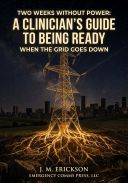
Two Weeks Without Power: A Clinician's Guide to Being Ready When the Grid Goes Down
by J. M. Erickson
Emergency Comms Press
If the power grid experienced an interruption lasting months, those using electricity would quickly recognize how dependent they really are. Before an interruption occurs, Erickson says, what's critical is having a two-week plan. FEMA recommends two weeks of supplies for sheltering in place; that initial plan can stretch to fill a month, a season, or even a year as conditions continue. What some may not realize is what being prepared for those two weeks looks like. For a family of four, it may involve stocking up on more than fifty gallons of water and having shelf-stable calories available. For others, it may mean ensuring medication and medical equipment are in working order in case the power goes out.
A power grid blackout may feel like something straight out of a science fiction universe, but it's a very real danger. Outside his work as a clinician, Erickson has created several science fiction worlds, including the Heart of Darkness series, the Prometheus series, the Intelligent Design series, and the Birds of Flight series. His decades of experience as a clinical social worker in Massachusetts also taught him to see what someone is rather than what they say. He honed his ability to assess individuals both diagnostically and behaviorally.
Among these experiences was supervising residential programs for the state departments of mental health, youth services, and youth and family services, as well as running a fifty-two-bed residential program and hospital-diversion program for emotionally disturbed children at the Robert F. Kennedy Children's Action Corps. His clinical and life experiences taught him the importance of adapting before one is ready and recognizing what's happening early rather than simply relying on gear.
The book was originally intended for his two adult children, born in 1995 and 1997, part of a generation that has known only a world powered by electricity. This artificial biosphere, as Erickson puts it, may have left young adults today unsure of what to do in an emergency when the power goes out. What's useful about this approach to preparation is that it can reassure someone who is just beginning to explore these topics. Some books in this area may inadvertently overwhelm an already nervous person seeking answers to their list of questions. In these sections, they can cut through some of their anxiety and begin preparing one thing at a time in an easy, brief, and to-the-point way.
One of the gems of this resource is its extensive collection of appendices. For those who appreciate interactive field worksheets or role assignments and activity lists, this section offers practical tips to print out and discuss as a family, with friends, or with roommates. What's especially interesting are the passages about communication channels, such as radio, and wound care for two weeks without a doctor. Despite the many details and steps involved in managing a crisis like a power outage, the concise presentation makes this a quick, informative introduction to what to do, what not to do, and how to take that first confident step.