
 |
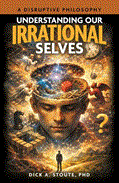
Understanding Our Irrational Selves: A Disruptive Philosophy
by Dick A. Stoute, PhD
Archway Publishing
This eleven-chapter book focuses on the author's belief that the human brain is irrational. As an analytical philosopher, he examines models of fight and build, with fight-build being his new model of philosophy. This looks not only at our rational selves of thought, but also at the so-called irrational selves of feeling. Building helps us notice feelings that influence our thought process and be more flexible than fight, which is more concrete. Combining the two allows for linear reasoning alongside circular reasoning, since we are both rational and irrational/nonrational. We need to be aware of the impact of feelings throughout all of our processes instead of "knowing" the truth. The text also examines this as relative to language theory, philosophical conundrums, and focuses on various philosophers and their theories, especially Einstein, and an examination of Einstein's work as compared to the author's.
This intellectual examination of a philosophical concept is well written, and the author does a good job of making it readable for those without a background in philosophy, although such a background would help readers fully grasp what is being discussed in these pages. The text traces the author's process of developing his model and offers helpful examples for the reader to ponder. It also uses repetition to clarify complicated material, and it includes a sense of humor. It also includes a thoughtful process and a valuable summary chapter. Useful work from other professionals throughout the book is featured, and the book is followed by a significant bibliography.