
 |
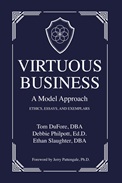
Virtuous Business: A Model Approach: Ethics, Essays, and Exemplars
by Tom DuFore, Debbie Philpott, and Ethan Slaughter
Skyward Imprint
The Virtuous Business Model (VBM) offers a framework for improving decision-making for leaders and organizations. Two triangles represent the virtuous organization and virtuous leader. The model applies Be-Know-Do to decisions made both individually and organizationally. A virtuous organization defines itself by economic, social, and spiritual capital; a virtuous leader gains a reputation professionally, personally, and spiritually. For an organization, this shows up in its principles, proficiency, service, sincerity, and creativity. In a leader, it takes the form of integrity, respect, inclusivity, character, and courage. For example, a leader must clarify their inner center, where their deepest values reside, to stay steady and truly lead. Biblical stories such as Esther's, presented through a mise en abyme, or story-within-a-story structure, take leadership emergence theory a step further by illustrating how a leader's influence develops.
As leaders continue to grow, "Part III: VBM Definitions and Questions" serves as a useful reference and filter for regularly assessing themselves and their organizations. These two-page resources are concise, accessible, and practical for leaders on the go. One of the best resources is the "Questions for Reflection and Discussion," with ten to eleven questions each, neatly organized by descriptive headers (e.g., Be-Know-Do, Integrity, Character, etc.). The book's longer essays balance high-level discussions for academics, researchers, philosophers, and students with practical insights for leaders to consider over morning coffee with their children or on a plane ride to their next meeting. What is wonderful about this collection of essays is that it doesn't shy away from deep topics—unlike leadership books that stay surface level—to challenge the decision-making (and growth) of leaders and organizations. Quotes and poems like Robert Frost's lift one beyond inner reflection, inspiring creativity and fresh perspectives. Ultimately, this collection pushes leaders to look inward, think deeply, and translate those reflections into better decisions.